Last Updated on September 2, 2026 by Karl Thompson
Churches, denominations, sects and cults are the four main types of religious organisation you need to know for A-level sociology. The differences between them come down to five things:
- Size and membership — how many members, and who joins
- Monopoly on truth — whether the organisation claims to be the only route to salvation
- Commitment — how much the organisation demands of members
- Organisation and leadership — bureaucratic hierarchy or charismatic leader
- Relationship to wider society — accepting, indifferent or hostile
This typology comes mainly from Ernst Troeltsch and H.R. Niebuhr, and it is examined in the religious organisations section of the AQA beliefs in society module, which is an option on Paper 2.

Summary grid: churches, denominations, sects and cults
| Church | Denomination | Sect | Cult | |
|---|---|---|---|---|
| Size | Very large | Large, but one of several | Small | Small and loosely bounded |
| Membership | Inclusive — members are born into it | Inclusive — drawn from all sections of society | Exclusive — conversion is conscious and voluntary | Open, but members behave more like customers |
| Typical members | All social classes | All social classes | Often the poor and the marginalised | Often affluent and middle class |
| Monopoly on truth | Yes | No — tolerant of other faiths | Yes | No — tolerant of other beliefs |
| Commitment demanded | Low to moderate | Moderate, sometimes with restrictions on behaviour | Very high — may require withdrawal from society | Very low |
| Leadership | Bureaucratic hierarchy of paid, trained clergy | Formal hierarchy with paid clergy | A charismatic leader, no hierarchy of paid officials | Little formal structure; often a practitioner offering a service |
| Relationship to the state | Closely tied to it | Separate from it, and believes in that separation | Not aligned with it | No relationship |
| Attitude to wider society | Accepts and supports it | Broadly accepts it | Opposed to it | Accepts it |
| Examples | The Roman Catholic Church; the Church of England | Methodists, Baptists, Pentecostals | The Branch Davidians, the People’s Temple, the early Methodists | Scientology, Transcendental Meditation, the Human Potential Movement |
As with any scheme of categorisation, many real-world organisations will not fit exactly into every row. Some sects have middle-class members; some appeal exclusively to one ethnic group. These are ideal types — deliberately simplified models used as a starting point for understanding the diversity of religious organisations, not descriptions any single organisation matches perfectly. Saying so in an exam is itself an evaluation point.
The Church
Ernst Troeltsch (1912, translated 1931) used the term ‘church’ to refer to a large, hierarchically organised religious institution with an inclusive, universal membership and close links to the state.
Troeltsch identified five characteristics:
- Churches have very large memberships, and those memberships are inclusive — you are usually born into a church rather than converting to it.
- Churches claim a monopoly on the truth: they present themselves as the only legitimate route to salvation.
- Churches have large, bureaucratic, hierarchical structures.
- Churches have professional, paid clergy who are formally trained and ordained.
- Churches are closely tied to the state.
Criticisms of the concept of the church
Steve Bruce (1996) argues that this definition may have been accurate for pre-modern Christian societies, but that since the Reformation — and especially with the growth of religious pluralism — it no longer describes the organisations that actually call themselves churches today.
Take the Church of England. It does not have universal membership. It does not claim a monopoly on the truth; it is broadly tolerant of other faiths. And while it remains formally established, its links to the state are far weaker than they once were. On Troeltsch’s five criteria, the Church of England only really qualifies on organisational structure.
HOWEVER, the concept still works reasonably well outside Britain. The Roman Catholic Church in Ireland or Poland, or the Orthodox Church in Greece, fit Troeltsch’s model far more closely — which suggests the problem is less with the concept itself than with applying a model built from European Christian history to a religiously plural society.
The Denomination
H.R. Niebuhr (1929) was the first sociologist to distinguish clearly between a church and a denomination, working from a study of religion in the United States. Denominations share some, but not all, of the features of churches.
Niebuhr identified six characteristics:
- Like churches, denominations draw members from all sections of society: they are inclusive.
- Like churches, they have formal, hierarchically organised bureaucratic structures.
- There are usually several denominations in a society, so no single one has universal appeal.
- Denominations do not claim a monopoly on the truth.
- Unlike churches, a denomination does not identify with the state and generally believes in the separation of church and state.
- Some denominations place restrictions on members’ behaviour — the Methodists and Pentecostals, for example, on alcohol.
Niebuhr’s more important argument is about movement between the categories. He argued that sects tend to become denominations over time. The first generation of members joins through conversion and is intensely committed; their children are born into the organisation rather than choosing it, and commitment weakens. As the organisation grows it acquires property, paid officials and respectability, and its hostility to wider society fades. The early Methodists began as a sect and ended as a denomination. This is sometimes called the denominationalisation of sects.
Steve Bruce suggests denominations have become more important as religious pluralism has increased, precisely because a plural society cannot sustain a single organisation claiming a monopoly on truth.
Criticisms of the concept of the denomination
The category may be too broad to be useful. There is genuine disagreement about where particular organisations belong — the Jehovah’s Witnesses are classified as a denomination by some sociologists and as a sect by others, because they have a formal organisational structure like a denomination but claim a monopoly on truth and demand a level of commitment more typical of a sect.
The Sect
According to Troeltsch, the sect is close to the opposite of the church.
Troeltsch’s key characteristics of sects:
- They have significantly smaller memberships than churches.
- Their membership is drawn disproportionately from the lower social classes and marginalised groups.
- They are not aligned with the state.
- They do not accept the norms and values of mainstream society. Sects are detached from society and in opposition to it.
- They demand a high level of commitment and have a high level of integration. Members may be expected to withdraw from society altogether.
- Membership is not inclusive. It has to be conscious and voluntary — you cannot be born into a sect in the way you can be born into a church.
- Sects claim a monopoly on the truth.
- Sects have a charismatic leader who is generally perceived to be special, rather than a hierarchy of paid officials.
Steve Bruce argues that the first sects in modern Europe formed when groups broke away from an established religion over disagreements about how it should be interpreted. That origin in schism is the feature that most reliably distinguishes a sect from a cult.
Sects also tend to be unstable. They often grow quickly around a charismatic leader, and they can collapse just as quickly — when the leader dies, when a prophecy fails, or when the second generation proves less committed than the first. Those that survive tend to become denominations.
Criticisms of Troeltsch’s sect category
Very few real organisations tick all eight boxes, which suggests the category may be too exclusive to be useful.
Roy Wallis argued that religious groups outside the mainstream vary too much to be handled by a single category, and proposed a threefold typology of new religious movements instead: world-rejecting, world-accommodating and world-affirming. Only the world-rejecting type resembles Troeltsch’s sect at all closely.
Note the distinction carefully, because it is commonly got wrong: Wallis’s typology classifies new religious movements, not sects. It is a separate classification that sits alongside the church–denomination–sect–cult typology rather than subdividing it. See the posts on world-rejecting, world-accommodating and world-affirming NRMs.
The Cult
Steve Bruce (1995) defines a cult as a loosely knit group organised around shared themes and interests, but without any sharply defined or exclusive belief system.
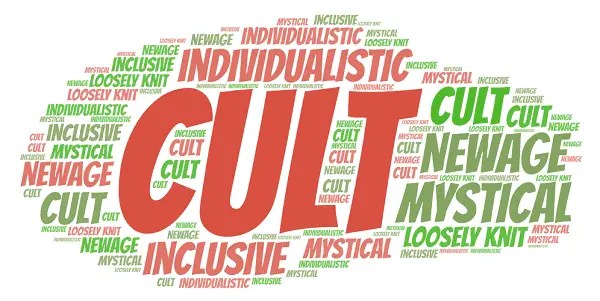
Key features of cults:
- Cults lack a fixed religious doctrine. Their beliefs are loose and open to a wide range of interpretation by members.
- They are far more individualistic than other forms of religion — the focus is usually on the personal development of the member rather than on worship or community.
- Members behave more like customers than believers. They come and go as they please, and pick which activities to take part in.
- Unlike sects, cults have very few rules and demand very little commitment.
- They are tolerant of other religious beliefs.
Cults correspond closely to Wallis’s category of world-affirming new religious movements. Scientology, Transcendental Meditation and the Human Potential Movement are the standard examples.
The difference between a sect and a cult
This is the distinction students most often get wrong, and it is worth being precise about because exam questions ask for it directly.
Sects break away; cults start fresh. Stark and Bainbridge argued that the defining difference is origin. A sect is the product of schism — it splits from an existing religious organisation and keeps most of that religion’s beliefs, claiming to be the purer version of them. A cult is either an entirely new religion or one imported from another culture, so it has no parent organisation to have broken away from.
Everything else follows from that. A sect claims a monopoly on truth because it believes it has recovered the true version of the religion it left. A cult makes no such claim because it is not competing for the same ground.
Stark and Bainbridge also subdivided cults by how organised they are:
- Audience cults are the least organised. There is no formal membership at all — people consume the ideas through books, podcasts or lectures. Astrology works like this.
- Client cults involve a practitioner offering a service to a client, much like a therapist. Transcendental Meditation began as one.
- Cult movements are the most organised and demand the most, approaching the commitment level of a sect. Scientology is the usual example.
The media uses the word ‘cult’ to mean something quite different. When a world-rejecting movement turns dangerous and its members are harmed or killed, newspapers reach for ‘cult’ — the People’s Temple at Jonestown, the Branch Davidians at Waco. Sociologically these are sects: they broke away from established Christianity, they claimed a monopoly on truth, and they demanded total commitment. Being able to point this out, and to note that ‘cult’ is a loaded everyday term that sociologists use in a narrower and more neutral way, is a straightforward evaluation mark.
Evaluating the typology
The four categories are useful for organising a complicated field, and they remain examinable, but there are three limitations worth knowing.
They are ideal types, not descriptions. Troeltsch built them from European Christian history, and real organisations sit between the categories rather than inside them. The Jehovah’s Witnesses problem is not a failure of classification so much as evidence that the categories have fuzzy edges.
They fit modern society better than postmodern society. Postmodernists argue that religion has become individualised: people assemble their own beliefs from whatever is available rather than belonging to an organisation at all. A typology built around types of membership struggles with a society in which fewer people are members of anything. Cults, notably, are the category that has grown — which fits the postmodern account of religion as a consumer choice.
The word ‘cult’ carries baggage the concept does not. Because the everyday meaning is so different from the sociological one, using the term at all invites confusion. Wallis’s NRM typology and Stark and Bainbridge’s subdivisions are both attempts to get around this.
Exam application: a practice question
This is a practice question written for revision purposes, not a past AQA paper. It follows the format of the 10-mark ‘outline and explain’ questions that appear on Paper 2.
Outline and explain two differences between sects and cults. (10)
Remember that there are no marks for evaluation on the 10-mark ‘outline and explain’ questions. Two points, each developed properly, is what earns the marks. Contrast this with the 10-mark ‘analyse’ questions, where you must take your points from the item and where analysis is credited.
Point one: sects and cults have different origins.
Sects are formed through schism. A group breaks away from an established religious organisation because it disagrees about how that religion should be interpreted, and it claims to represent the true version of the faith it has left. Steve Bruce argues this is how the first sects in modern Europe formed, and the early Methodists breaking from the Church of England are the standard example. Cults, by contrast, do not break away from anything. Stark and Bainbridge argue that cults are either entirely new religions or religions imported from another culture, which is why Scientology and Transcendental Meditation have no parent organisation. This difference in origin explains why sects claim a monopoly on truth while cults do not: a sect believes it has recovered something the parent organisation lost, whereas a cult is not competing for the same territory.
Point two: sects and cults demand very different levels of commitment.
Troeltsch argued that sects demand a high level of commitment and have a high level of integration, sometimes requiring members to withdraw from wider society altogether, and that they are held together by a charismatic leader rather than a paid hierarchy. Cults demand almost nothing. Bruce describes them as loosely knit groups without a sharply defined belief system, and members function more as customers than as believers — free to come and go, and to select which activities they take part in. This difference also shapes how long each type survives: sects are intense but unstable and often collapse when their leader dies or a prophecy fails, whereas cults, demanding little, can persist indefinitely with a shifting membership.
Beliefs in society revision bundle for sale

If you like this sort of thing then you might like my ‘beliefs in society’ revision bundle.
The bundle contains the following:
- seven mind maps covering the sociological perspectives on beliefs in society. In colour!
- Three 10 mark ‘outline and explain’ practice exam questions and model answers
- Three 10 mark ‘analyse using the item’ 10 practice exam questions and answers
- Three 30 mark essay questions and extended essay plans.
The content focuses on the AQA A-level sociology specification, at £4.99.
I taught A-level sociology for eighteen years and was an AQA examiner for eight of them, across all three papers, so I know what the mark schemes actually reward.
Signposting and Related Posts
This post has been written for students studying the beliefs in society option as part of the AQA’s A-level sociology course, where religious organisations are examined on Paper 2.
The obvious next topic is Roy Wallis’s typology of new religious movements, which is a separate classification covering the same organisations from a different angle.
From there, students usually move on to the New Age Movement, the loosest and most individualised form of religious organisation, and to postmodernity and the New Age.
For exam practice on this topic, see two ways in which social change may lead to the growth of sects.
For the module as a whole, see my beliefs in society page.
Please click here to return to the homepage – ReviseSociology.com
Sources
Chapman et al, Sociology AQA A-Level Year 2 Student Book
Troeltsch, E. (1912, trans. 1931) The Social Teaching of the Christian Churches
Niebuhr, H.R. (1929) The Social Sources of Denominationalism
Wallis, R. (1984) The Elementary Forms of the New Religious Life
Stark, R. and Bainbridge, W.S. (1985) The Future of Religion
Bruce, S. (1995) Religion in Modern Britain; Bruce, S. (1996) Religion in the Modern World
Haralambos and Holborn, Sociology Themes and Perspectives